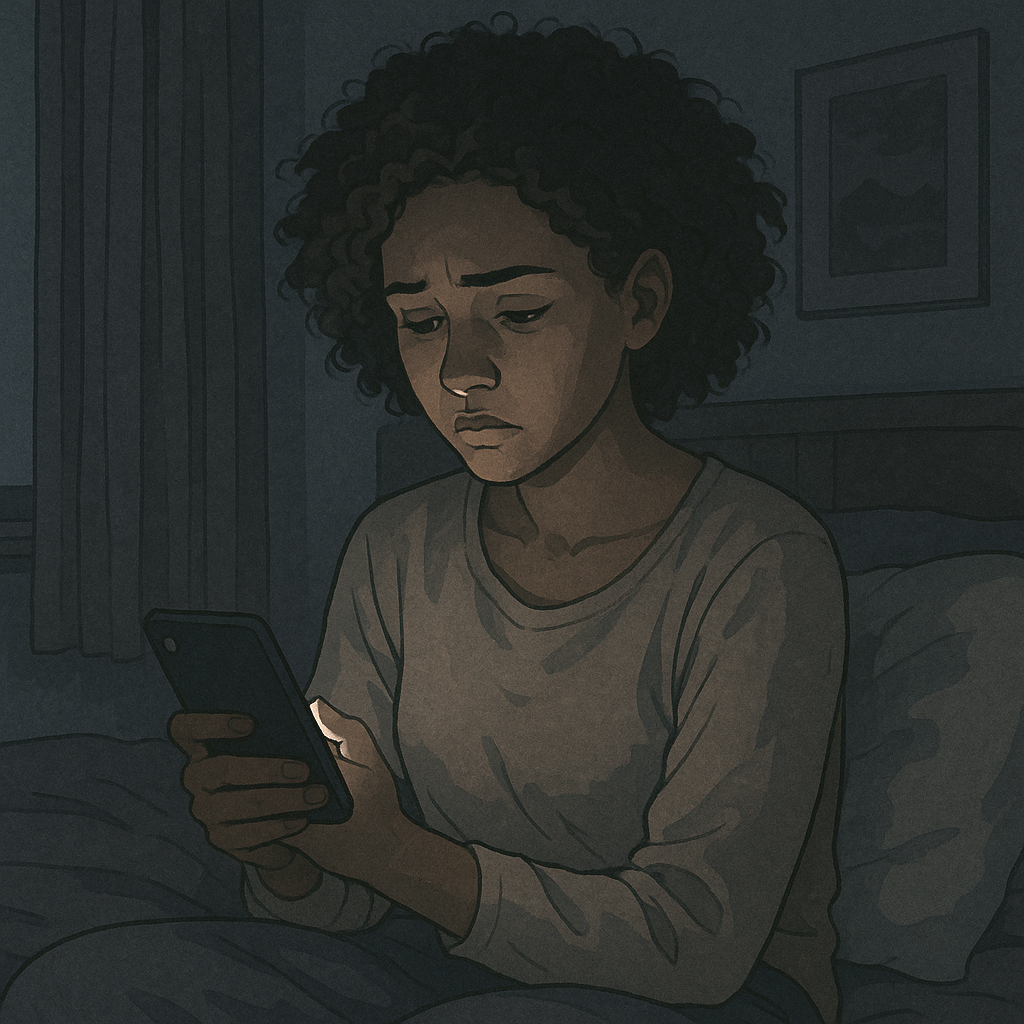
You notice it quietly, the way you notice you’ve stopped hearing birdsong or that a regular barista has vanished from your morning routine. One day, your friend stops posting. Stops replying. Stops existing, digitally.
There was no fight, no crescendo of goodbye. Just a pixel fade. A slow dissolve.
In our always-on era, digital absence feels louder than physical absence ever did.
It sneaks in like a draft through a cracked window. Unseen, but suddenly chilling. And by the time you realize what’s missing, it’s already gone.
And there you are, staring at a glowing screen, wondering how someone could vanish into thin bandwidth.
I used to talk to Mae almost daily. Voice notes. Random memes. Tiny pockets of our lives passed back and forth across invisible threads of light. She lived three states over, but our friendship was rooted in that intimacy of knowing exactly when someone last opened your message. We never met in person, but she knew things about me my own family didn’t—the kind of things you only share at 2 a.m. when you feel both brave and a little unhinged.
We met on a message board for queer writers. She left a comment on a piece I wrote about heartbreak and parallel universes, and within days we were talking every night. She sent me voice notes while walking her dog, Sadie. I sent her photos of street art and my weird dinners. She knew how I liked my tea. I knew the name of her childhood stuffed animal.
We had our rhythms: Sunday morning check-ins. Thursday rants about capitalism. Random, beautiful tangents on gender, grief, or the plot of whatever absurd prestige drama we were watching. Once, when I was sick and stuck in bed, she read me Sylvia Plath poems over voice note. Her voice had a roundness to it that made even the darkest verses feel like comfort.
Then, she vanished.
No dramatic sign-off. No “I need a break.” Just… gone. Her Instagram, deactivated. Her number, unresponsive. Our mutual spaces online—the Slack group, the Discord, even her Medium page—silent. A week passed. Then a month. I checked obituaries (don’t pretend you haven’t). I searched Reddit for her username. I googled her name like it might summon her.
I messaged a few mutuals. Most hadn’t noticed yet. Some assumed she was taking a break. One person said, “She does this sometimes,” but couldn’t elaborate. That made it worse. Was it a pattern I had simply never witnessed before? Or had I been part of the final act?
Digital ghosting isn’t new. But grieving someone who’s technically still alive? That’s a newer kind of ache.
We mourn in pings now.
There are no rituals for this kind of loss. No casseroles, no funerals, no shoulder touches. Just unread messages. Just the cold echo of “delivered” with no reply.
The grief is private. Lonely. There’s no social script for it. You can’t call into work and say, “I need a day—someone I only know online disappeared.”
We were never taught how to say goodbye to someone who simply logged off.
And let me be clear: this isn’t about romantic ghosting. That’s its own brand of emotional terrorism. I’m talking about friendships. Chosen family. The people who knew your playlists, your pet’s weird habits, the secret thing you were working on. The people you vented to during a breakdown, who replied with voice notes that made you laugh through tears.
When they go, the silence isn’t just hurt. It’s haunted.
I kept opening our last chat thread. I reread her messages, tried to guess something in the tone. Had she sounded tired? Was there a hint of goodbye I had missed? I listened again to the last voice note she sent—a minute and forty-seven seconds of her walking through her neighborhood, describing a tree with purple blossoms she said looked like “something out of a dream if dreams smelled like wet clay and lilac.”
I began to scroll back further and further, looking for clues. The time she mentioned needing a social detox. The month she quietly left a group chat without saying anything. A cryptic tweet from December about “feeling like a ghost.”
Was that the moment she began to disappear?
Or had she always been edging toward it, just waiting for the silence to catch up?
Why do people disappear?
The reasons are rarely simple. Mental health breaks. Burnout. Rebirth. Rebellion. Safety. Shame. Healing. Sometimes people disappear because they’re trying to stop being someone. Other times, they’re trying to become someone else.
Some folks just can’t bear the mirror of online life anymore. The curated self can become a cage. The notifications, a form of surveillance. There’s pressure to be present, witty, kind, creative, engaged, vulnerable—but not too vulnerable. It’s exhausting.
We curate our lives for each other, then suddenly someone stops curating. It shakes something primal. Our digital webs are illusions of permanence. When a strand snaps, the spider in our chest panics.
There’s also the unspeakable: sometimes people disappear to protect themselves. From stalkers. From exes. From employers. From a world that reads vulnerability and uses it as ammunition.
The internet is a haven, and it is also a hunting ground.
And sometimes, people simply disappear because they’ve run out of words. Or courage. Or faith that anyone is listening.
I don’t blame her. But that doesn’t mean I stopped missing her.
Grief in the age of the feed.
I started dreaming about Mae. In the dreams she was always mid-sentence, laughing, turning toward me. I’d wake up before she finished whatever she was saying.
I think my brain was trying to close a tab that wouldn’t respond.
I told a mutual friend, “I miss her,” and she winced like I’d said someone died. Maybe, in a way, someone had. Not Mae, but the access to Mae. And access, in the digital era, feels indistinguishable from existence.
It’s disorienting to miss someone you never hugged. To ache over a name that might never appear again in your notifications. To grieve in silence while the world scrolls on.
And the memories hit at odd times. A certain font on a tea box that looked like one Mae designed for a zine. A sunset that looked exactly like the one she sent me from her rooftop in June. Even the opening chords of a Phoebe Bridgers song that we once dissected line by line over texts that stretched into dawn.
Every ping that isn’t her, every empty thread—a reminder.
What does it mean to be gone but not dead?
That’s the question I kept turning over. Our language is woefully unprepared for this. We have terms like estrangement, like absence, but not the vocabulary to describe losing someone who still breathes somewhere, just not in your life.
There is no closure. Just refresh.
How do we mourn digital ghosts?
Maybe we start by naming the loss. Allowing it to be real, even if it’s invisible.
Maybe we stop dismissing online connections as “not real” friendships. Because if the grief is real, so was the bond.
Maybe we create our own rituals. I lit a candle for Mae. I wrote her a letter and tucked it inside a book she’d once recommended. I whispered, “Thank you for what you were.”
And then I let her go.
Letting go didn’t mean forgetting. It meant allowing her absence to take shape, to exist without question. It meant holding space without expectation.
A year later, Mae’s Medium page blinked back to life. She had written an essay titled “The Quiet Exit.” It was about overwhelm. About losing herself in the noise. About choosing, finally, to vanish. I read it three times.
She didn’t mention me. She didn’t have to.
It was enough to know she was alive. That her voice still existed. That somewhere, she had found the words.
I didn’t message her. It wasn’t necessary. Some goodbyes are unspoken. Some friendships exist only in a certain season, and trying to resurrect them disturbs something sacred.
I simply lit another candle. And I said thank you again.
Not everyone comes back. Not everyone is supposed to. And some absences aren’t about you at all.
But it’s okay to feel it. To miss someone who disappeared without a trace. To grieve their absence like a ghost town of inside jokes and half-sent thoughts.
Because here’s the quiet truth no algorithm will teach you:
Sometimes, the deepest goodbyes don’t echo. They vanish.
And we learn to love in silence, too.